
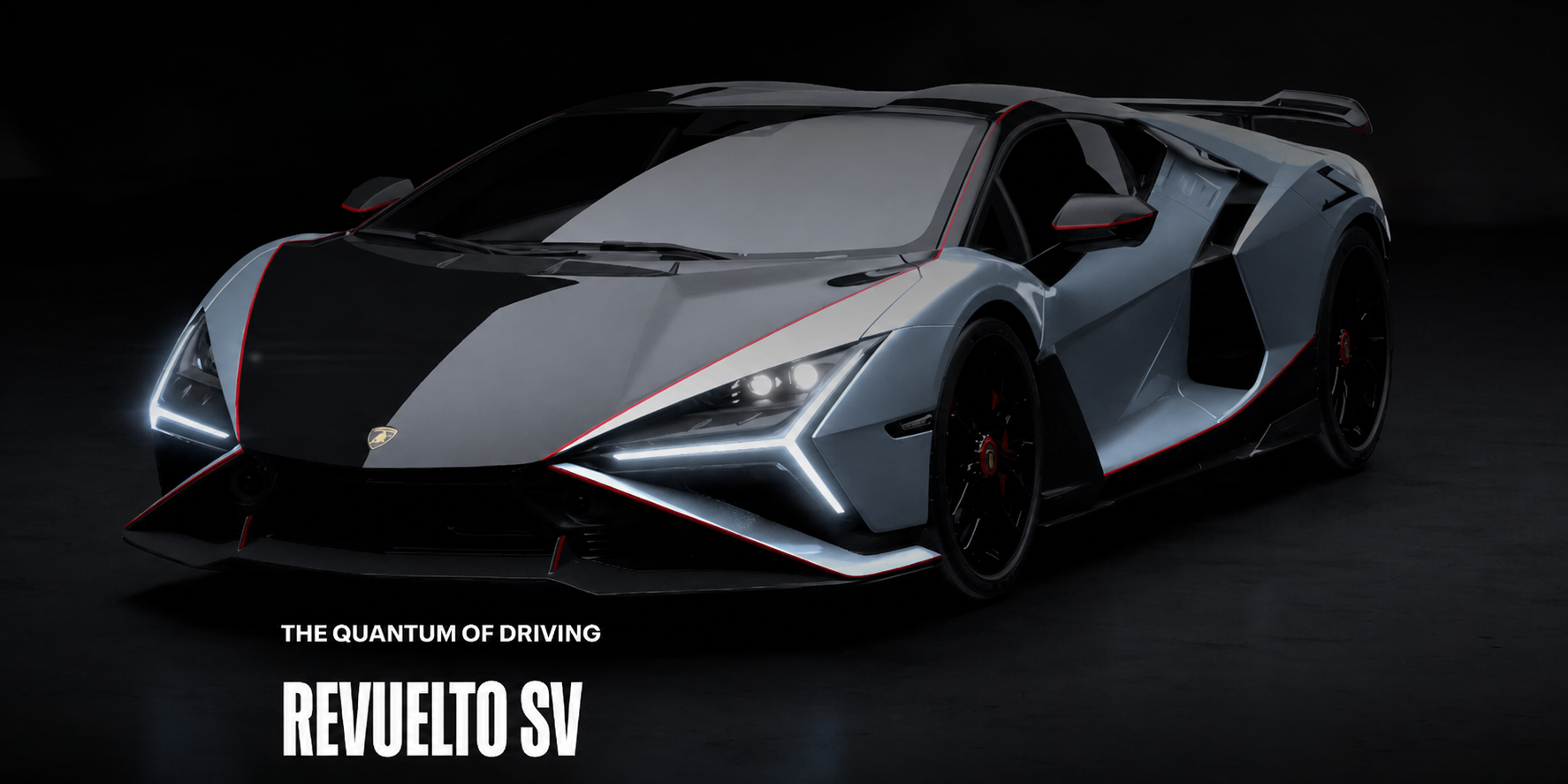
Lamborghini unveiled the Revuelto SV at The Quail during Monterey Car Week, positioning it as the most powerful and fastest production car the company has ever built. Behind the headline horsepower numbers, though, the car’s real story is in the engineering: a substantially upgraded battery system and a new real-time sensor-driven braking system that reflect how hybrid supercars are starting to borrow more from motorsport telemetry and controls engineering than from traditional car design.
A Powerful Battery Built for Consistency
The standard Revuelto already combines a naturally aspirated V12 with three electric motors. For the SV variant, Lamborghini nearly doubled the battery’s capacity, moving from 3.8 kWh to 7.3 kWh, with the new pack capable of delivering up to 190 kW.
That upgrade contributes 50 additional horsepower over the base Revuelto, pushing total system output to 1,065 CV (roughly 1,050 hp) and 1,425 Nm of torque. But the more interesting claim isn’t the peak number: Lamborghini says the redesigned battery system delivers up to four times greater performance consistency than the standard car, meaning the electric motors can sustain their contribution over repeated hard laps instead of tapering off after a single aggressive run.
That’s a real engineering problem in high-performance hybrids. Batteries under sustained heavy load tend to heat up and throttle their output to protect the cells, exactly the kind of degradation a track-day buyer would notice. A battery designed explicitly for repeatability, rather than just a bigger one-time power spike, suggests real attention to thermal management and cell architecture, even though Lamborghini hasn’t published the deeper technical specifics.
Real-Time Sensor System Built Into the Brakes
The more novel piece of engineering is a new Integrated Brake Control system, which uses what Lamborghini calls a “6D sensor” mounted close to the car’s center of gravity. That sensor measures acceleration and angular velocity across all three axes (lateral, longitudinal, and vertical), essentially giving the car a continuous, high-resolution read on exactly how it’s moving through space at any given moment.
That data feeds into an Integrated Vehicle Estimator that uses Kalman filtering, a mathematical technique commonly used in aerospace and robotics to estimate a system’s true state from noisy sensor data, to calculate the car’s speed, slip angle, and the real-time friction coefficient between the tires and the road surface. The resulting estimates then inform the braking system in real time, allowing it to intervene more precisely to prevent wheel lock and shorten stopping distances by as much as 10%, according to Lamborghini.
In practice, this is the kind of sensor fusion and predictive estimation you’d expect to see in autonomous vehicle systems or advanced driver-assistance platforms, applied here purely to make a manual, driver-controlled supercar brake more intelligently under extreme conditions.
A Dedicated Track Mode Built From Racing Data
The SV also introduces a new driving mode called Pilota, activated by a dedicated selector on the steering wheel. Unlike the standard Strada, Sport, and Corsa modes, Pilota unlocks a five-stage traction control system adapted directly from Lamborghini’s GT3 racing program, allowing a driver to fine-tune how much electronic intervention they want on track. Lamborghini says the system also adjusts automatically based on tire wear and track surface conditions.
The new upgrades are a useful data point on where automotive engineering is headed. The Revuelto SV’s braking system in particular reflects a broader shift in how modern performance cars increasingly rely on the same category of real-time estimation and sensor fusion techniques used in robotics and autonomous systems, just applied to make a human driver’s inputs more effective rather than to replace them.
Pricing hasn’t yet been announced. Production of the Revuelto SV will be capped at 1,963 units, a reference to the year Lamborghini was founded, and will be reserved primarily for existing customers and collectors
Leave a Reply