
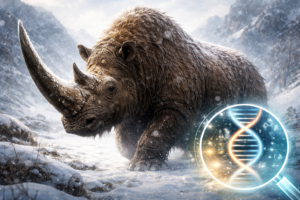
Scientists have successfully reconstructed the genome of a woolly rhinoceros using biological material found in the stomach of a wolf pup that lived more than 14,000 years ago, an unusual discovery that opens a new window into the genetics of extinct species.
The findings come from an international research team involving scientists from Cardiff University, Stockholm University, and other European institutions, and were published in the journal Genome Biology and Evolution.
The wolf pup was discovered preserved in Siberian permafrost and is believed to have died around 14,400 years ago during the final stages of the last Ice Age. When researchers examined the remains, they found traces of the pup’s last meal, which included tissue from a young woolly rhinoceros.
Despite the DNA having passed through the wolf’s digestive system and spent millennia frozen underground, scientists recovered enough genetic material to reconstruct the rhino’s genome. Researchers say this is the first time a complete genome of an Ice Age animal has been reconstructed from material recovered from another animal’s stomach.
The reconstructed genome was compared with genetic data from older woolly rhino specimens, including samples dated to around 18,000 and 49,000 years ago. The comparison found no evidence of population decline, increased inbreeding, or other signs of genomic deterioration shortly before the species disappeared. The results suggest woolly rhinoceroses remained genetically stable until very near the end of their existence.
This challenges the idea that woolly rhinoceroses were in a long, slow genetic decline before going extinct. Instead, the evidence supports a scenario in which the final collapse happened rapidly, likely linked to environmental change during a period of warming near the end of the last Ice Age.
Beyond its implications for understanding extinction, the study demonstrates that modern genetic and computational techniques can extract high quality genomic information from rare and unconventional material. Researchers say similar approaches may help scientists study other extinct animals using samples that would previously have been considered unusable.

Leave a Reply